The pitch landing in mid-market boardrooms this year goes like this: don't rip out the ERP, don't wait for a modernization program, just put agents on top. Oracle announced four supply chain agents that handle inventory, procurement, manufacturing readiness, and replenishment. SAP spent Hannover Messe talking about agentic manufacturing. The overlay story is attractive for a reason: rip-and-replace is expensive, disruptive, and usually unnecessary, and the vendors are right about that part.
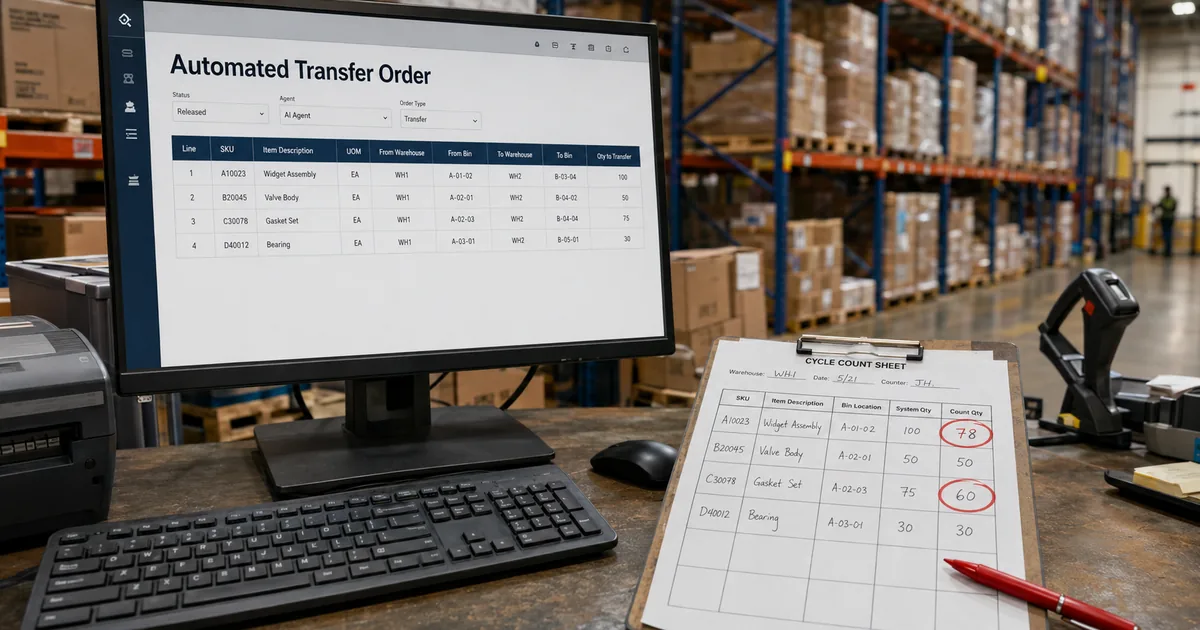
Here's the part the pitch skips. An overlay doesn't sit on top of your operations. It sits on top of your records. The agent doesn't see your warehouse; it sees what your ERP says about your warehouse. If those are two different things, you haven't deployed autonomous operations. You've deployed autonomous errors.
The layer the pitch skips
The appetite is real. Kaufman Rossin's mid-market research, summarized in Automation World this month, found 91% of manufacturers plan to increase AI investment. The foundation is not. Only 27% of the manufacturers surveyed have a data warehouse or data lake, against 60% for the broader mid-market. Some 45% still run on siloed data. Legacy integration is their top AI barrier at 55%, well above the mid-market average. And 73% remain stuck in the testing phase. Not one manufacturer in the study had reached the stage where AI is simply how the business runs.
None of that is a model problem. Every one of those numbers describes the record layer: the item masters, inventory positions, routings, and vendor records the agent would act on. A concrete version of the problem: if the MES calls a machine "7B" and the maintenance system calls the same asset "CNC-007B," an agent that spans both systems cannot make a decision either system would trust. Multiply that by every duplicated SKU and every stale bin location, and "put an agent on top" starts to mean something different.
The buffer you didn't know you had
Operations run on records like these every day, and mostly get away with it. The reason is people. A planner sees a transfer suggestion that doesn't smell right and checks the floor before releasing it. A buyer recognizes that the reorder point on that item has been wrong since the last physical count. The workarounds are invisible, unpaid, and everywhere. They are the buffer between imperfect records and real consequences.
An acting agent removes that buffer. That is the entire point of an agent, and the entire risk. A copilot suggests; an overlay executes. It places the purchase order, releases the transfer, reroutes the shipment. Redwood Software's survey of 300 manufacturing professionals shows how thin the safety net is underneath: only 40% have automated exception handling, even though they rank exceptions among their most disruptive processes, and 78% have automated less than half of their critical data transfers. Redwood's CEO described manufacturers as "hitting the limits of siloed execution." Hand an agent authority inside that environment and the sequence is predictable. It acts on a wrong record, downstream systems treat the action as fact, and the error compounds until someone reconciles it at month-end.
This is the same lesson procurement taught earlier this year at Bristol Myers: deploying on imperfect data worked because every output passed through a bounded, reviewable checkpoint before money moved. An ERP overlay with execution authority has no such checkpoint unless you build one.
Sequence beats surgery
The answer is not rip-and-replace. The answer is sequencing the overlay the same way you'd sequence anything else that acts on your records.
Start with the records, not the use cases. Map where the data for your highest-value workflows actually lives and how clean it is. Kaufman Rossin's guidance points the same direction: one or two targeted integrations connecting the most-used systems beat a full enterprise overhaul, and the right first use cases are the ones where the data is already clean enough to trust.
Then give the agent authority the way you'd give a new hire authority. Bounded, on records with a named owner, with exceptions routed to a person, expanding as it earns trust. An agent rebalancing inventory across two sites with clean item masters and a human approving transfers above a threshold is a production deployment. An agent with open authority across an ERP nobody has audited is a pilot that hasn't failed yet.
The overlay vendors are selling speed to value, and on decent records they can deliver it. But the question in front of you isn't the one on the slide. It isn't "can agents work with our ERP?" They can; that's what the connectors are for. The question is: which of our records would we let an agent act on without a person checking, and who owns each of those records when the agent gets it wrong?
If the answer is a short list with names attached, start there and expand. If the answer is silence, the overlay isn't skipping your ERP problem. It's about to inherit it.
Frequently asked questions
What is an agentic AI overlay on ERP?
Software agents that sit on top of an existing ERP, WMS, or TMS and take actions inside it: releasing transfers, placing purchase orders, rebalancing inventory, rerouting shipments. Unlike a copilot, which suggests actions for a person to approve, an overlay executes within whatever guardrails you set. Vendors position overlays as a faster alternative to replacing the ERP.
Do agent overlays remove the need to modernize our ERP?
No. The overlay acts on the ERP's records, so it inherits their condition. If item masters are duplicated or inventory positions are stale, the agent executes on wrong data at machine speed. What overlays genuinely remove is the need for rip-and-replace. The record layer still has to be fixed, but you can fix it in targeted slices rather than a multi-year program.
Why do most mid-market manufacturers stall at the AI pilot stage?
The evidence points to the data layer, not the models. In Kaufman Rossin's mid-market research, 73% of manufacturers were still in testing, only 27% had a data warehouse, and legacy integration was the top barrier at 55%. Pilots succeed in narrow, clean-data pockets and stall when scaling requires records and integrations that don't exist yet.
What should we fix before giving an agent authority in our ERP?
Three things. First, the records the agent will act on: item masters, inventory positions, vendor data for the target workflow. Second, ownership: a named person accountable for each record set and for the agent's output. Third, containment: exception routing and approval thresholds so a wrong action surfaces before it compounds. Fix these for one workflow, deploy, and expand.
Are agent overlays a bad idea for mid-market manufacturers?
No. On decent records with bounded authority they are often the fastest route to measurable value, and far cheaper than replacing the ERP. The failure pattern isn't the overlay. It's granting execution authority across records nobody has audited or owned. Sequence the record work first, scope the agent's authority, and the overlay earns its keep.