
Engineering, Construction & Infrastructure (ECI)
AI in ECI Must Be Built Around Project Control.
Engineering, Construction & Infrastructure companies operate in complex, high-risk environments where small process failures become expensive quickly.
AI in ECI Depends on Field-to-Office Control
Engineering, construction, and infrastructure companies operate across estimates, contracts, schedules, change orders, field updates, labor, equipment, vendors, billing, and project controls. The issue is rarely a lack of information. The issue is that information moves through too many handoffs, spreadsheets, emails, PDFs, project tools, and undocumented workarounds.
Foundation AI Advisory helps ECI companies strengthen the data and workflows that connect the field, project management, finance, and leadership before applying AI. Without that foundation, AI will accelerate the same problems that already create margin fade, billing delays, schedule slippage, and unclear accountability.
AI can support project reporting, change order tracking, document review, risk identification, schedule analysis, field updates, and cash flow visibility. But it only works when project data is structured, ownership is clear, and workflows reflect how work actually gets done.
- Project reporting
- Change order management
- Document review
- Risk identification
- Schedule analysis
- Field updates
- Billing support
- Cash flow visibility
Where the Methodology Meets Engineering, Construction & Infrastructure (ECI).
The business depends on estimating discipline, project setup, field execution, change order control, subcontractor coordination, document management, billing, collections, labor tracking, equipment utilization, safety, compliance, and project closeout. When those workflows are fragmented, leadership loses visibility into margin, cash flow, schedule risk, and execution quality.
AI does not solve those problems on its own.
In ECI businesses, AI applied too early can create more risk than value. If project data is incomplete, change orders are not captured consistently, field notes live in disconnected systems, drawings and specifications are poorly governed, or billing depends on manual follow-up, AI may simply process confusion faster. It may summarize incomplete project records. It may draft communications without proper context. It may miss critical exceptions because the workflow underneath it was never designed.
Foundation AI Advisory starts with the operating model.
Data First. Workflow Second. AI Third.
Foundation AI Advisory evaluates this industry through its core methodology — in order.
Data Curation & Governance
ECI firms need reliable data across customers, projects, contracts, estimates, budgets, schedules, drawings, RFIs, submittals, change orders, labor, materials, equipment, invoices, safety records, compliance documents, and closeout requirements. Foundation AI Advisory evaluates where the data lives, who owns it, how it is updated, which system is the source of truth, and whether leadership can trust the reporting.
This matters directly to margin and cash flow. If change orders are late, project cost data is incomplete, or billing milestones are unclear, profitability and working capital suffer.
Workflow Optimization
Foundation AI Advisory reviews how work moves from opportunity to estimate, from estimate to project setup, from project setup to field execution, and from field execution to billing and closeout. We look for manual handoffs, duplicated entry, unclear approvals, missing documentation, field-to-office breakdowns, and exception paths that depend too heavily on memory or individual follow-up.
In construction and infrastructure, cycle time matters because delays compound. A late approval delays field work. A missing document delays billing. A poorly tracked change order creates margin leakage. A weak closeout process traps cash.
AI Design & Implementation
AI can create value in ECI when it operates inside defined workflows. It may help classify project documents, summarize field reports, extract data from contracts, support RFI review, identify missing closeout items, draft project communications, flag billing issues, route exceptions, or support executive project review.
But AI should not replace project accountability. Human review points are essential in contracts, change orders, safety, compliance, claims, and customer commitments. Foundation AI Advisory designs AI-supported workflows with clear decision rights and escalation paths.
The outcome is not AI adoption for its own sake. The outcome is stronger project control.
Tied to Margin, Throughput, Cycle Time, Cash Flow, Risk, and Visibility.
What Foundation AI Advisory delivers, by audience.
Better visibility into project performance and risk before problems become expensive.
Improved billing discipline, cleaner project cost data, faster collections, and better margin control.
Clearer workflows, better field-to-office coordination, and fewer preventable delays.
A structured approach to integrating project systems, document repositories, ERP, finance, and AI tools without creating uncontrolled complexity.
Related Thinking
 Part 1 of 5
Data: The Constraint You Can’t Outrun
Why mid-market AI initiatives stall on data quality, ownership, and structure before any model is involved.
Read →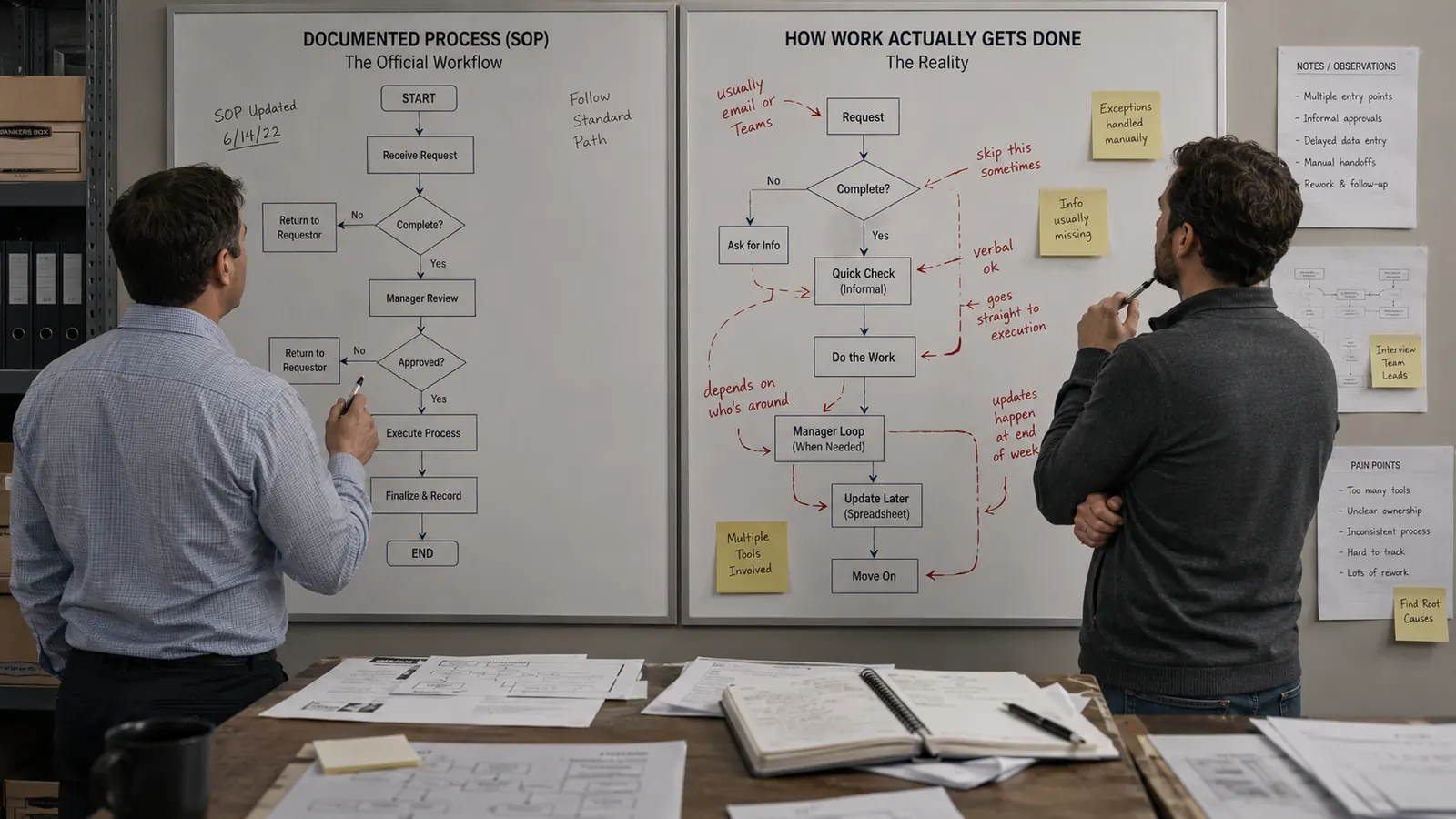 Brief
Brief
How Work Actually Gets Done vs. How It’s Documented
The gap between documented process and operating reality is where AI most often fails.
Read → Part 2 of 5
Process: Fix the System Before You Accelerate It
Why workflow redesign has to come before automation, and what changes when it does.
Read →ECI companies win by controlling execution.
AI is useful only when it improves that control.