
Energy & Natural Resources
AI in Energy and Natural Resources Must Support Reliability, Compliance, and Operating Control.
Energy and natural resource companies operate in environments where reliability, safety, compliance, asset performance, and capital discipline matter as much as efficiency.
AI in Energy and Natural Resources Requires Reliable Operating Evidence
Energy and natural resources companies operate in environments where asset reliability, regulatory exposure, field conditions, capital planning, safety, maintenance, and reporting discipline matter. The cost of weak data is not just inefficiency. It can create operational risk, compliance exposure, downtime, and poor capital allocation.
Foundation AI Advisory helps energy and natural resources operators strengthen the data governance, workflow control, and operating visibility required before AI is applied. The work starts with the reliability of the information used to make decisions, not with the AI model.
AI can support maintenance planning, asset monitoring, field reporting, compliance workflows, forecasting, document review, and operational visibility. But those use cases depend on traceable data, clear ownership, and workflows that reflect actual operating conditions.
- Maintenance planning
- Asset reliability
- Field reporting
- Compliance support
- Forecasting
- Document review
- Capital planning
- Operational visibility
Where the Methodology Meets Energy & Natural Resources.
These businesses often manage distributed assets, complex field operations, regulatory obligations, maintenance schedules, environmental data, contractor activity, inventory, financial controls, and long-cycle capital projects. When the data and workflows underneath those areas are fragmented, the business takes on operational and financial risk.
AI can support better execution, but only after the foundations are clear.
Data First. Workflow Second. AI Third.
Foundation AI Advisory evaluates this industry through its core methodology — in order.
Data Curation & Governance
Energy and natural resource companies depend on reliable data across assets, work orders, inspections, maintenance history, contractors, environmental records, safety incidents, inventory, production data, permits, compliance documentation, capital projects, and financial reporting.
The challenge is not simply having data. Most companies have plenty of data. The challenge is whether the data is structured, governed, accessible, and reliable enough to support decisions.
If asset records are inconsistent, inspection data is incomplete, regulatory documentation is scattered, or maintenance history is difficult to analyze, AI will not create dependable operating insight. It may create summaries, but those summaries will only be as reliable as the underlying records.
Foundation AI Advisory evaluates the data environment with business outcomes in mind: asset uptime, risk exposure, maintenance cost, project performance, cash flow, compliance confidence, and executive visibility.
Workflow Optimization
We review how work actually moves through the organization: field inspections, maintenance planning, contractor coordination, compliance review, incident reporting, procurement, capital project controls, inventory management, and executive reporting.
In energy and natural resources, workflow failure can be expensive. A missed inspection, late maintenance action, unclear approval, weak contractor handoff, or incomplete compliance record can create operational, financial, and regulatory exposure.
Foundation AI Advisory identifies where workflows depend too heavily on manual follow-up, disconnected systems, informal knowledge, or delayed reporting. Then we help define cleaner operating paths with clearer ownership, better controls, and stronger visibility.
AI Design & Implementation
AI can create value in areas such as inspection summary, maintenance triage, document classification, compliance support, contractor record review, field report analysis, asset issue detection, procurement support, and management reporting.
But AI must be designed carefully. In regulated or safety-sensitive environments, AI should support decision-making, not replace accountable review. Foundation AI Advisory emphasizes human-in-the-loop design, clear escalation logic, auditability, and governed data sources.
The business objective is practical: improve reliability, reduce risk, accelerate review cycles, and strengthen visibility into operational performance.
Tied to Margin, Throughput, Cycle Time, Cash Flow, Risk, and Visibility.
What Foundation AI Advisory delivers, by audience.
Better control over asset reliability, risk, and capital discipline.
Improved cost visibility, better project controls, cleaner reporting, and reduced exposure from poorly governed records.
Faster issue identification, clearer work execution, and stronger coordination across field and office teams.
A structured path for connecting operational data, compliance records, field systems, and AI-enabled workflows without creating uncontrolled complexity.
Related Thinking
 Part 1 of 5
Data: The Constraint You Can’t Outrun
Why mid-market AI initiatives stall on data quality, ownership, and structure before any model is involved.
Read → Part 5 of 5
Governance: The System That Holds It Together
Lightweight governance for mid-market AI: ownership, controls, escalation paths, and human oversight at the right points.
Read →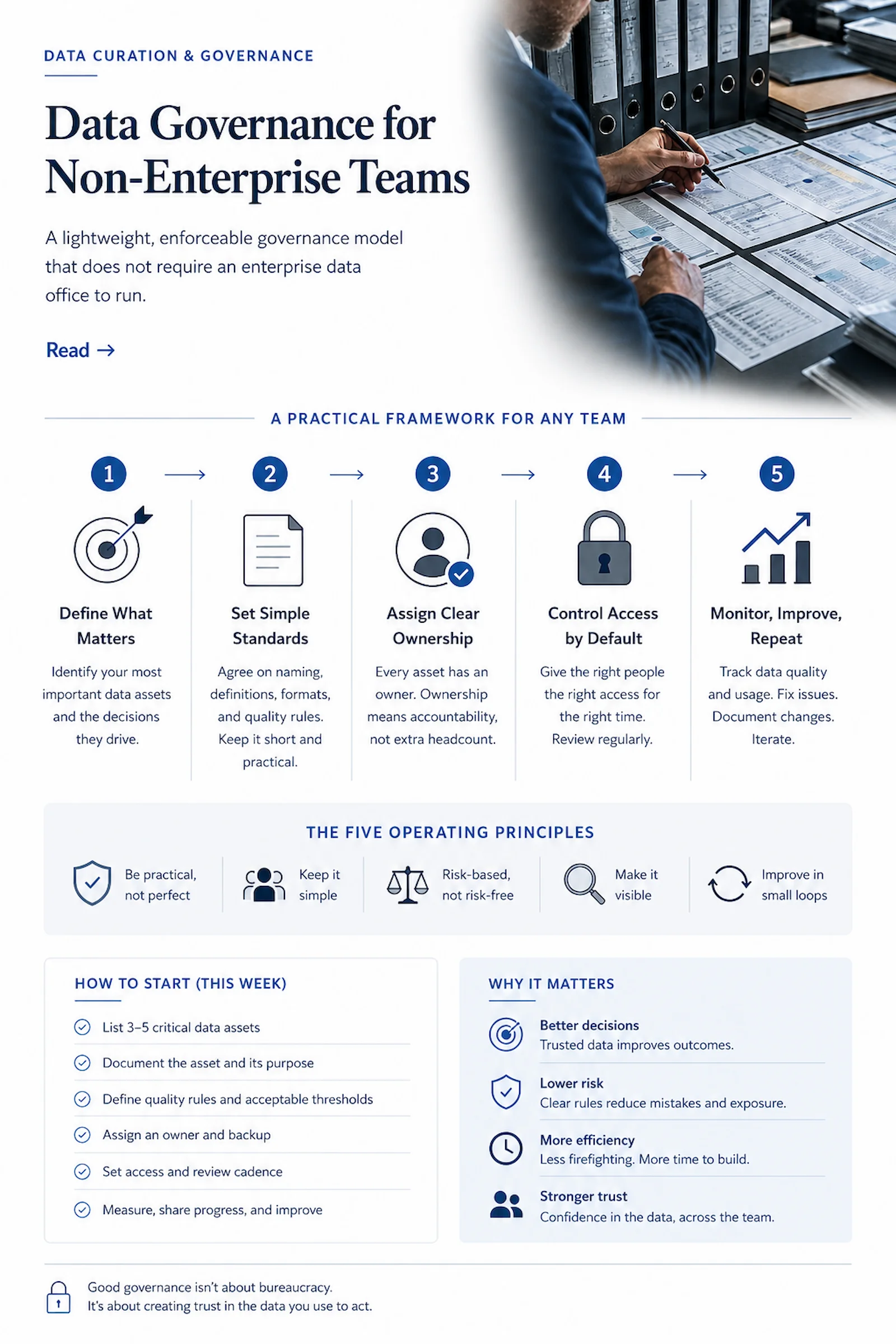 Infographic
Data Governance for Non-Enterprise Teams
A lightweight, enforceable governance model for mid-market teams that need trusted data without enterprise data-office overhead.
Read →Energy and natural resources companies should not pursue AI as a standalone initiative.
They should pursue better operating control. AI earns its place when it supports reliability, compliance, and disciplined execution.