
Specialty Manufacturing
AI in Specialty Manufacturing Must Respect High-Mix, Low-Volume Reality.
Specialty manufacturing is not standard production at scale. It often involves high-mix, low-volume work, custom specifications, engineered products, complex estimating, special materials, customer-specific requirements, manual judgment, and frequent exceptions.
AI in Specialty Manufacturing Has to Respect High-Mix Reality
Specialty manufacturers often operate in high-mix, low-volume, engineer-to-order, configure-to-order, or custom production environments. Standard AI assumptions break when jobs, routings, materials, labor, quality requirements, and customer specifications vary heavily.
Foundation AI Advisory helps specialty manufacturers improve the data and workflows behind quoting, engineering, production planning, materials, quality, costing, scheduling, and reporting before applying AI. The goal is to make complex operations more visible and controllable without forcing the business into a generic model.
AI can support quote analysis, engineering review, scheduling, material planning, quality insights, margin analysis, and exception management. But it depends on governed item data, job history, customer requirements, routing assumptions, and ownership of decision points.
- Quote analysis
- Engineering review
- Scheduling
- Material planning
- Quality analysis
- Margin visibility
- Exception management
- Operational reporting
Where the Methodology Meets Specialty Manufacturing.
That reality makes generic AI advice dangerous. A specialty manufacturer cannot simply automate its way into better performance if the underlying data, standards, routings, quoting logic, and production workflows are inconsistent.
The business depends on knowing what is being made, how it should be made, what it should cost, what materials are required, which constraints affect production, and where exceptions appear. If that information is scattered across spreadsheets, emails, legacy ERP records, tribal knowledge, and undocumented workarounds, AI will amplify the disorder.
Data First. Workflow Second. AI Third.
Foundation AI Advisory evaluates this industry through its core methodology — in order.
Data Curation & Governance
Specialty manufacturers need reliable data across customers, specifications, estimates, materials, routings, labor assumptions, machine capabilities, quality requirements, production history, vendors, inventory, revisions, and actual costs.
The difficulty is that every job may be different. That makes governance more important, not less. The company needs enough structure to compare estimates to actuals, learn from prior work, price intelligently, plan capacity, control material usage, and identify margin leakage.
Foundation AI Advisory evaluates whether the data supports business decisions. Can leadership see which jobs are profitable? Can estimators access prior work? Can production understand requirements clearly? Can finance explain variance? Can operations identify repeatable patterns inside custom work?
Workflow Optimization
Foundation AI Advisory reviews the flow from inquiry to estimate, estimate to order, order to engineering or job setup, job setup to production, production to quality, quality to shipping, and shipping to billing and closeout.
In specialty manufacturing, small workflow issues create outsized cost. A missed specification can cause rework. A weak handoff can delay production. An incomplete estimate can destroy margin. Poor revision control can create quality risk. A late purchasing signal can delay the entire schedule.
Foundation AI Advisory identifies where the workflow depends too heavily on individual memory, manual interpretation, duplicate entry, or undocumented exception handling.
AI Design & Implementation
AI can support specialty manufacturing when the scope is clear. It may help retrieve prior job history, summarize specifications, compare customer requirements, assist quote preparation, identify missing information, classify exceptions, support quality documentation, generate internal summaries, or help leadership review variance patterns.
But AI should not replace expert judgment in estimating, engineering, quality, or customer commitments. Foundation AI Advisory designs AI support around human accountability, clear review points, and governed source data.
The business outcome is better control of complexity.
Tied to Margin, Throughput, Cycle Time, Cash Flow, Risk, and Visibility.
What Foundation AI Advisory delivers, by audience.
Clearer visibility into where custom work creates or destroys value.
Better estimating discipline, improved job margin visibility, cleaner variance analysis, and reduced leakage.
Improved handoffs, fewer delays, stronger production planning, and better exception control.
A practical architecture that supports high-mix operations without forcing the business into rigid, unrealistic workflows.
Related Thinking
 Part 2 of 5
Process: Fix the System Before You Accelerate It
Why workflow redesign has to come before automation, and what changes when it does.
Read → Part 1 of 5
Data: The Constraint You Can’t Outrun
Why mid-market AI initiatives stall on data quality, ownership, and structure before any model is involved.
Read →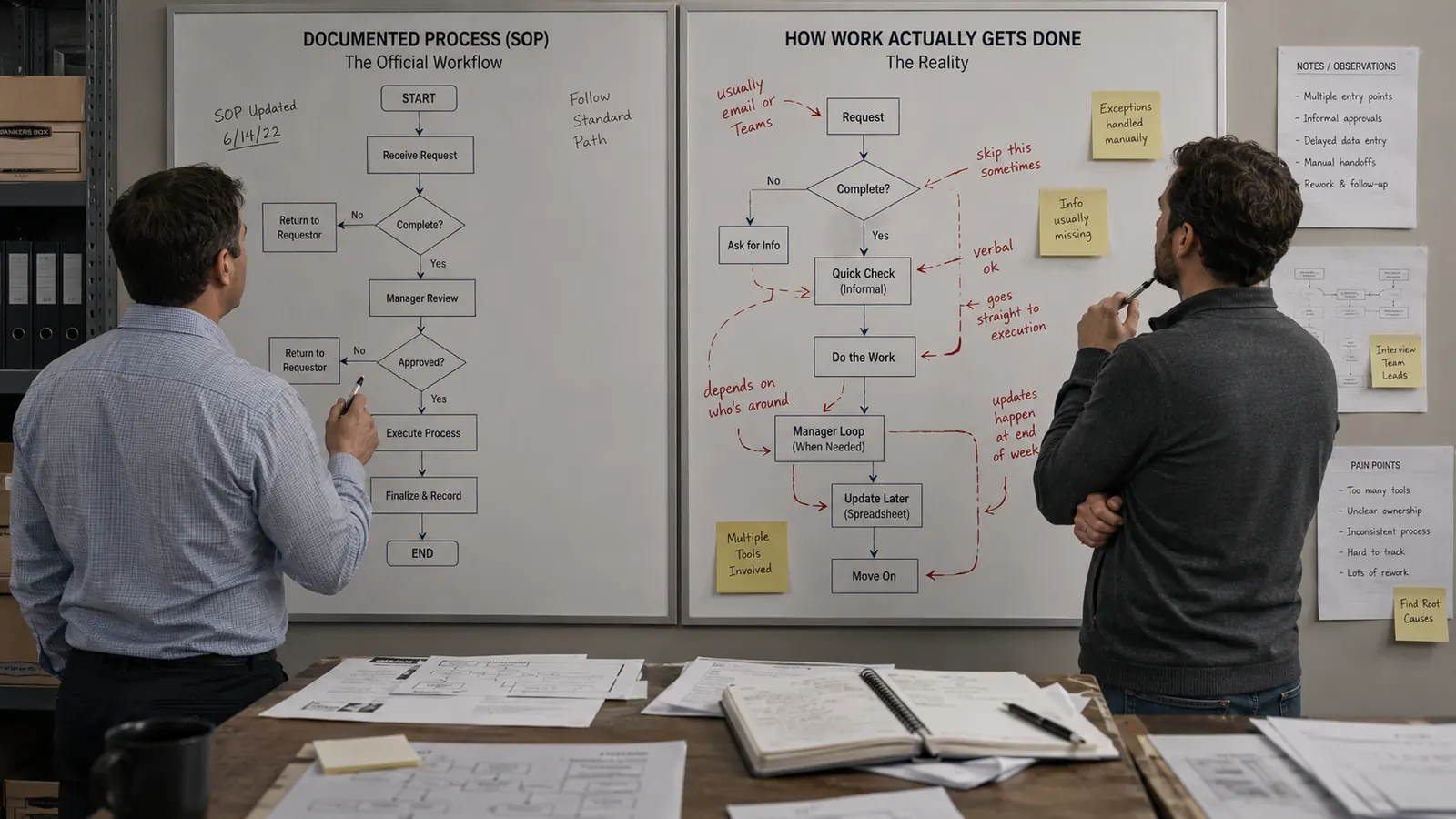 Brief
Brief
How Work Actually Gets Done vs. How It’s Documented
The gap between documented process and operating reality is where AI most often fails.
Read →Specialty manufacturing needs AI that respects operational complexity.
It earns its place when it helps the business structure complexity without pretending the work is simple.