
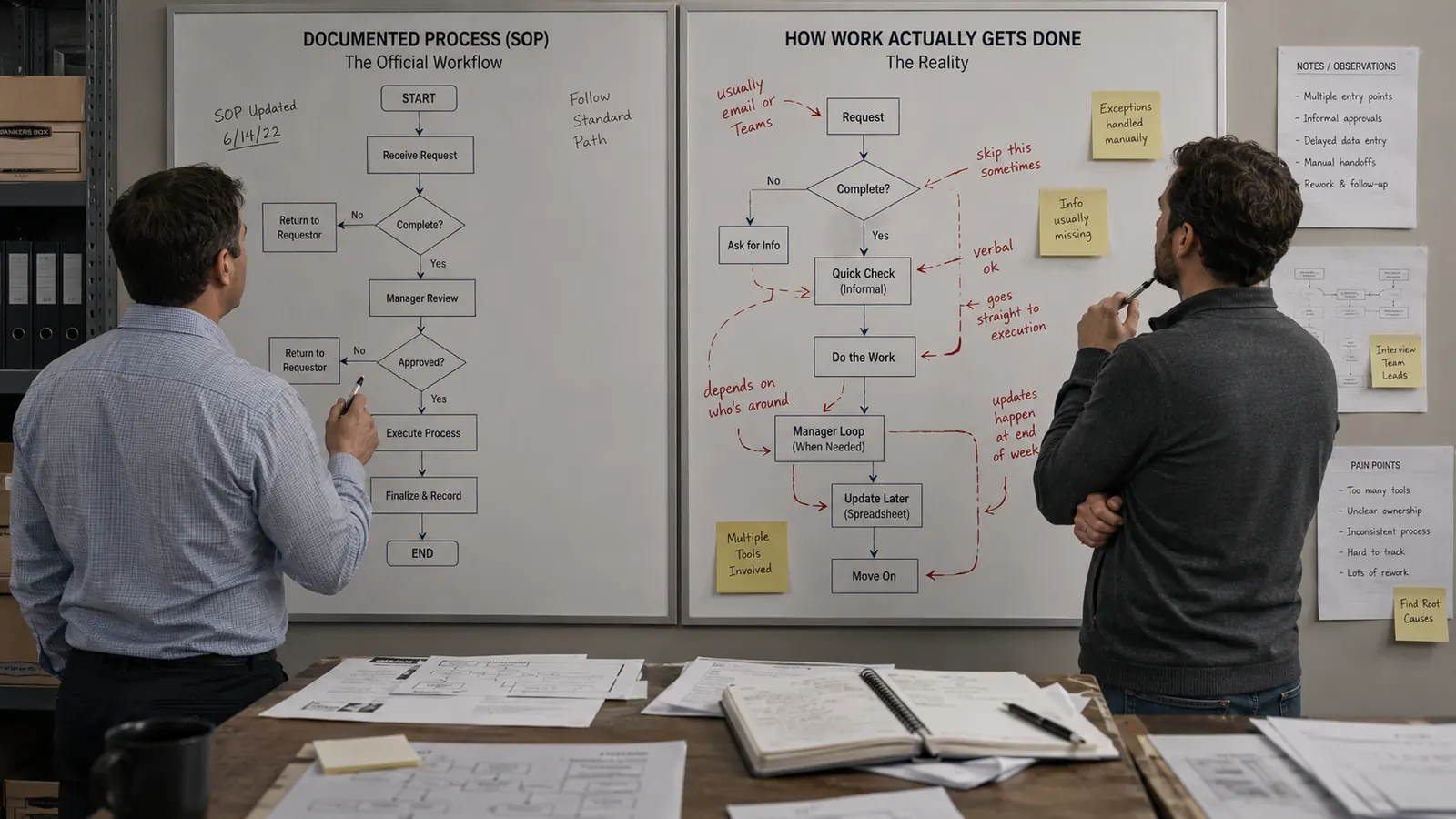
Every mid-market business has two versions of every workflow.
The documented one — the SOP, the training deck, the process map a consultant drew up two cycles ago.
And the real one — the version the team actually runs every day, with the workarounds, the side spreadsheets, the verbal approvals, and the one person who knows what to do when the standard path does not apply.
The gap between the two is where the operating cost lives.
Where the gap shows up
The gap is rarely in one obvious place. It accumulates across small compromises that each made sense at the time.
A field on the order form is left blank because the team agreed it does not matter for repeat customers. The SOP still requires it.
An approval is given over Teams instead of through the workflow tool because the person doing the work did not have access to the tool that day. The SOP still says approvals route through the system.
A pricing exception is granted by phone and entered later. The SOP still says exceptions require manager sign-off in writing.
An invoice is held for a week because the project manager wants to verify a milestone. The SOP says invoices go out automatically on milestone completion.
None of these are scandals. Each one is a reasonable response to a real-world friction. Together, they describe a workflow that does not match its own documentation.
Why the gap matters now
For most of the last decade, the gap was tolerable. Experienced people held the workflow together. Operators learned the unwritten rules. New hires picked them up by working alongside the team. The business ran.
AI changes the math.
When AI is layered on top of the documented workflow, it executes against the documented version. When the documented version does not match reality, the AI's outputs do not match reality either. Pricing, approvals, exceptions, billing — all run faster, all run with the same gap, and now the gap is operationalized at scale.
The compromises that experienced operators absorbed silently become visible failures. Customers see the wrong price. Finance sees an invoice that should have been held. Compliance sees an approval trail that does not match the policy.
The gap was always there. AI just made it expensive.
What to do about it
Closing the gap is not a documentation project. It is an operating discipline.
Pick one workflow that matters. Map how it actually happens — through interviews with the people doing the work, not the people who wrote the SOP. Surface every compromise, every workaround, every exception path that lives in someone's head.
Then make a decision on each one. Some compromises become formalized because they are load-bearing. Some get removed because the original reason is gone. Some require a system change to remove the friction that made the workaround necessary.
The output is not a thicker binder. It is a workflow where the documented version and the real version are the same, and the data and decision rights underneath it are clear enough to support an agent.
Do this before the AI investment, not after. The cost of fixing the gap is small. The cost of running AI on top of the gap, then unwinding the outputs that resulted, is not.
The SOP is not the workflow. The workflow is the workflow. AI runs on the workflow.