Workflow Optimization: Fix the Process Before AI
Align how work actually moves across the business before applying automation or AI. Foundation AI Advisory identifies broken handoffs, undocumented exceptions, unclear ownership, and decision friction that slow throughput, leak margin, and increase operating risk.
Most companies do not have an AI problem first. They have a workflow problem, a decision-rights problem, or an ownership problem that AI will expose faster.
- Map how work actually moves across teams, systems, and exceptions
- Remove duplicated effort, manual workarounds, and decision bottlenecks
- Prepare workflows for automation, agentic systems, and governed AI execution
Foundation AI Advisory fixes the operating model before applying AI to the workflow.
Workflow Optimization Makes AI Operationally Safe
Before AI can extend a workflow, the workflow has to work. Workflow Optimization is the discipline of making how work actually gets done observable, repeatable, and controllable — defining decision points, clarifying handoffs, categorizing exceptions, and removing friction before automation is layered on top.
Most mid-market workflows are not designed; they evolved. Over years of system additions, vendor switches, staff turnover, and manual workarounds, what looks like a process is often a set of loosely connected actions held together by experience. Humans navigate the gaps without much trouble. AI cannot.
Foundation AI Advisory optimizes workflows before applying AI because automation amplifies whatever it inherits. A clean workflow makes AI a force multiplier on margin, throughput, and cycle time. A broken workflow turns AI into a risk multiplier — running faster but failing in the same places, more often, with less explanation.
Evaluate your workflow readiness →Most Processes Aren’t Designed. They’re Inherited.
Operators rarely set out to build inefficient workflows. They inherit them through growth, turnover, customer exceptions, system changes, acquisitions, and years of “just get it done.”
Over time, the workaround becomes the process.
The company may have documented procedures, but the real operating model often lives in inboxes, spreadsheets, side databases, tribal knowledge, and manual approvals. That creates a gap between how leadership believes the business runs and how work actually gets done.
-
Broken handoffs hide in plain sight.
Sales, operations, finance, service, and leadership may each believe the next team owns the next step. Work waits in inboxes, spreadsheets, status meetings, and undocumented follow-up calls. The result is cycle time that stretches without a clear owner.
-
The real workflow is not the documented workflow.
SOPs describe how the business intends work to happen. The actual business runs on what employees do when systems are incomplete, customer requirements change, or the standard path does not fit the situation.
-
Exceptions become normal operating procedure.
Rush jobs, customer-specific rules, pricing overrides, missing information, manual approvals, and special handling become embedded into the operating model. What should be controlled exceptions become part of daily throughput.
-
Decisions wait for the one person who knows.
Approvals, escalations, and judgment calls often depend on tribal knowledge. When that person is busy, unavailable, or leaves the company, the workflow slows, breaks, or becomes inconsistent.
-
Work moves through shadow systems.
Spreadsheets, side databases, email chains, sticky notes, personal checklists, and private trackers become the real control layer. Leadership loses visibility into status, risk, and accountability.
-
No one owns the full flow.
Each department optimizes its own piece. The customer, job, order, invoice, claim, or issue still has to move across the entire business. When nobody owns the end-to-end flow, the customer feels the friction and margin absorbs the cost.
This Is Where Margin Leaks Quietly.
Workflow problems do not announce themselves as process problems.
They appear as missed ship dates, delayed billing, rework, excess touches, duplicated entry, customer frustration, slow approvals, unclear priorities, overtime, and operating noise that leadership can feel but cannot easily trace.
The cost is not only labor. It is lost throughput, slower cash conversion, weaker customer experience, higher risk, and management time spent chasing work that should already be moving.
Teams redo work because upstream information was incomplete, late, inaccurate, or entered differently than expected.
Approvals sit idle because ownership, authority, escalation rules, or required inputs are unclear.
Customers experience delay and inconsistency even when individual teams are working hard.
The same information is entered, checked, reformatted, and reconciled across multiple systems.
AI accelerates the workflow it is given. If the workflow is fragmented, unclear, or dependent on rescue work, AI will scale the friction instead of removing it.
Automating a Broken Process Just Breaks It Faster.
AI does not remove friction by default.
It applies speed to the workflow underneath it. If that workflow depends on undocumented exceptions, unclear ownership, manual rescue work, inconsistent inputs, or shadow systems, AI will amplify the problem.
The right sequence is not tool selection first.
It is:
- Data Curation & Governance
Clarify the records, definitions, ownership, and controls that the workflow depends on. - Workflow Optimization
Redesign how work moves, who owns each step, where decisions happen, and which exceptions must be controlled. - AI Design & Implementation
Apply AI only where the workflow is stable, measurable, and ready to scale.
That sequence protects margin, improves throughput, reduces operating risk, and gives leadership visibility into what is actually happening.
What We Actually Do.
Foundation AI Advisory maps how work really moves through the business, not how it appears in a procedure document.
We identify the handoffs, decisions, exceptions, inputs, approvals, and control points that determine speed, accuracy, accountability, and risk. The goal is not a cleaner process map. The goal is an operating flow that can be measured, managed, improved, and eventually automated where it makes business sense.
Workflow Reality Mapping
We document how work actually moves across people, systems, departments, and exceptions.
This includes the official process, the informal workarounds, the manual checks, the decision points, and the places where employees compensate for system gaps.
Business impact: improves visibility, exposes hidden cycle-time delays, and gives leadership a factual operating baseline.
Handoff & Ownership Definition
We clarify who owns each step, who approves decisions, what information is required, and where work should move next.
The point is not documentation for documentation’s sake. The point is accountability that survives turnover, volume spikes, customer exceptions, and system constraints.
Business impact: reduces stalled work, duplicate follow-up, missed handoffs, and management escalation.
Exception Path Reduction
We identify recurring exceptions that have become embedded in the operating model.
Then we determine which exceptions should be standardized, eliminated, escalated, or controlled before they continue consuming capacity.
Business impact: protects margin, reduces rework, improves throughput, and limits the cost of custom handling.
Decision Flow Design
We define where decisions are made, what information is required, who has authority, and when escalation is needed.
A workflow is only as fast as its slowest unclear decision.
Business impact: shortens cycle time, improves consistency, reduces operating risk, and prevents approvals from becoming bottlenecks.
Automation Readiness
We determine where AI or automation can safely accelerate the workflow after the process is stable enough to support it.
If the flow still depends on rescue work, undocumented judgment, inconsistent inputs, or unclear ownership, it is not ready to scale.
Business impact: avoids failed AI spend, improves adoption, and focuses automation on measurable operational gains.
A Workflow the Business Can Actually Run, Measure, and Improve.
Foundation AI Advisory does not optimize workflows to make diagrams cleaner.
We optimize workflows so the business can move faster with less friction, less rework, fewer delays, stronger accountability, and better visibility.
The result is a business that can measure how work moves, identify where value leaks, and apply AI only where the foundation is strong enough to support it.
- Higher throughput
- Shorter cycle times
- Lower rework
- Faster decisions
- Better cash conversion
- Reduced operating risk
- Clearer accountability
- Better customer experience
- Stronger readiness for AI implementation
Before You Automate the Workflow, Understand It.
Most AI failures start before the model is ever selected. They start in workflows that are undocumented, inconsistent, manually rescued, or dependent on tribal knowledge.
Foundation AI Advisory helps operators see how work really moves, fix the friction that slows the business down, and prepare the operating model for responsible AI implementation.
AI Design & Implementation
Once the workflow is visible, stable, and measurable, the next step is applying AI where it improves execution without scaling hidden friction.
Recent Thinking on Workflow
 Part 2 of 5
Process: Fix the System Before You Accelerate It
Why workflow redesign has to come before automation, and what changes when it does.
Read → Article
Automating a Broken Process Scales the Problem
Automation amplifies whatever it inherits. A method for finding and fixing the workflow before AI extends it.
Read →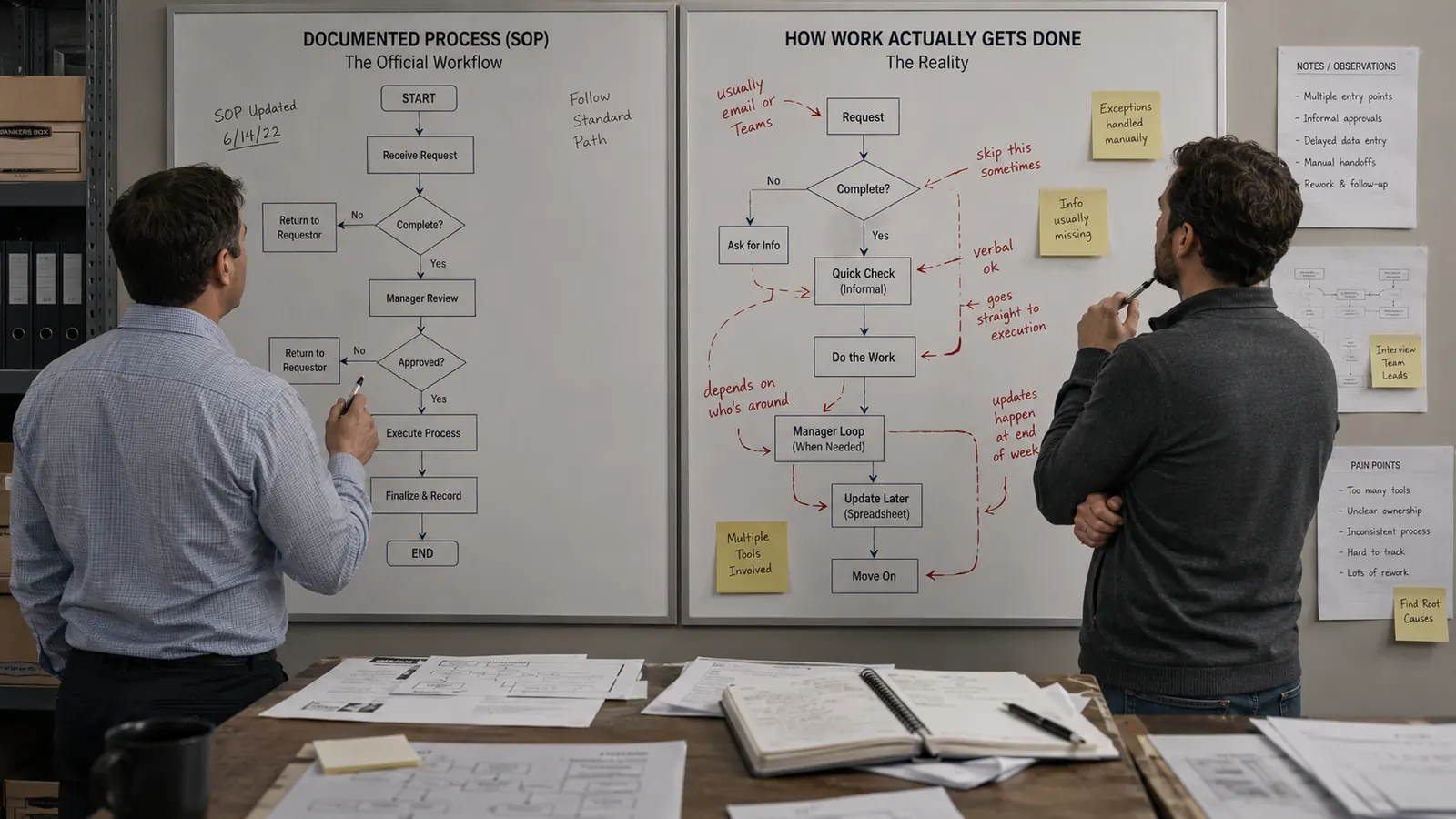 Brief
Brief
How Work Actually Gets Done vs. How It’s Documented
The gap between documented process and operating reality is where AI most often fails.
Read →Get Foundation AI Advisory’s running record on mid-market AI execution.
Insight assets for mid-market operators. Published when there is something worth publishing.
We do not share your information. Unsubscribe any time.