
Manufacturing & Industrial Production
Manufacturing AI Starts With the Operating Floor, Not the Model.
Manufacturing companies do not need more AI language. They need better control over margin, throughput, yield, schedule adherence, labor utilization, material usage, and operating visibility.
AI in Manufacturing Starts With the Operating Floor, Not the Model
Manufacturing companies do not need more AI language. They need better control over margin, throughput, yield, schedule adherence, labor utilization, material usage, and operating visibility. Foundation AI Advisory helps manufacturers improve the data and workflows underneath those outcomes before applying AI.
In most mid-market manufacturing environments, the constraint is not a lack of technology. The constraint is fragmented operating data, inconsistent process discipline, disconnected systems, and manual reconciliation between what happened on the floor and what leadership sees in reports.
AI can help manufacturing teams forecast demand, identify production bottlenecks, improve maintenance planning, support quality analysis, and reduce administrative drag. But those systems only work when item masters, production data, work orders, inventory records, costing assumptions, and process ownership are clean enough to trust.
- Demand and production forecasting
- Production planning
- Quality analysis
- Maintenance planning
- Inventory visibility
- Scheduling
- Margin analysis
- Management reporting
Where the Methodology Meets Manufacturing & Industrial Production.
In most mid-market manufacturing environments, the real constraint is not a lack of technology. The constraint is fragmented operating data, inconsistent process discipline, disconnected systems, and too much manual reconciliation between what happened on the floor and what leadership sees in reports.
That is where Foundation AI Advisory starts.
Manufacturing operations depend on clean data across customers, items, bills of material, routings, labor standards, inventory, work orders, machine capacity, scrap, rework, quality, purchasing, and shipping. When those records are incomplete or inconsistent, the business loses visibility into actual margin. Jobs may look profitable until labor, material variance, freight, overtime, scrap, or rework is properly applied. Estimating may drift from reality. Scheduling may depend on tribal knowledge. Finance may spend too much time explaining variance after the fact instead of helping operations prevent it.
AI cannot correct that by itself.
If AI is layered on top of poor item data, weak production standards, disconnected quality records, or informal scheduling logic, it will only accelerate flawed decisions. It may summarize bad information faster. It may route work based on incomplete status. It may generate confident explanations from records that were never governed properly.
Foundation AI Advisory’s approach for manufacturing follows a disciplined sequence.
Data First. Workflow Second. AI Third.
Foundation AI Advisory evaluates this industry through its core methodology — in order.
Data Curation & Governance
We evaluate whether the company has reliable operational data. That includes item masters, customer records, costing structures, production standards, inventory data, job history, quality records, equipment data, and management reporting. The objective is not a large enterprise data program. The objective is to determine whether the company can trust the information used to quote, schedule, produce, ship, invoice, and measure performance.
Workflow Optimization
We look at how work actually moves through the plant and office. Sales handoff, estimating, order entry, purchasing, planning, scheduling, production reporting, quality checks, inventory movement, shipping, invoicing, and job closeout all affect margin and throughput. Foundation AI Advisory identifies where work slows down, where rework appears, where approvals are unclear, where information is duplicated, and where the ERP does not reflect operational reality.
AI Design & Implementation
Only after the data and workflow foundation is understood do we identify where AI can create practical leverage. In manufacturing, AI may support document intake, quote preparation, production status summaries, exception detection, variance review, maintenance triage, quality issue classification, purchasing support, customer communication, or management reporting. But each use case must have clear inputs, owners, controls, exception paths, and measurable business impact.
The goal is not to make manufacturing AI-driven. The goal is to improve the business operating system.
Tied to Margin, Throughput, Cycle Time, Cash Flow, Risk, and Visibility.
What Foundation AI Advisory delivers, by audience.
Clearer visibility into where performance is improving or slipping.
Better margin visibility, cleaner costing, faster close support, and reduced spreadsheet dependency.
Improved throughput, shorter cycle times, fewer handoff failures, and better control over exceptions.
A more disciplined path for connecting systems, governing data, and applying AI without creating another layer of disconnected tools.
Related Thinking
 Part 2 of 5
Process: Fix the System Before You Accelerate It
Why workflow redesign has to come before automation, and what changes when it does.
Read →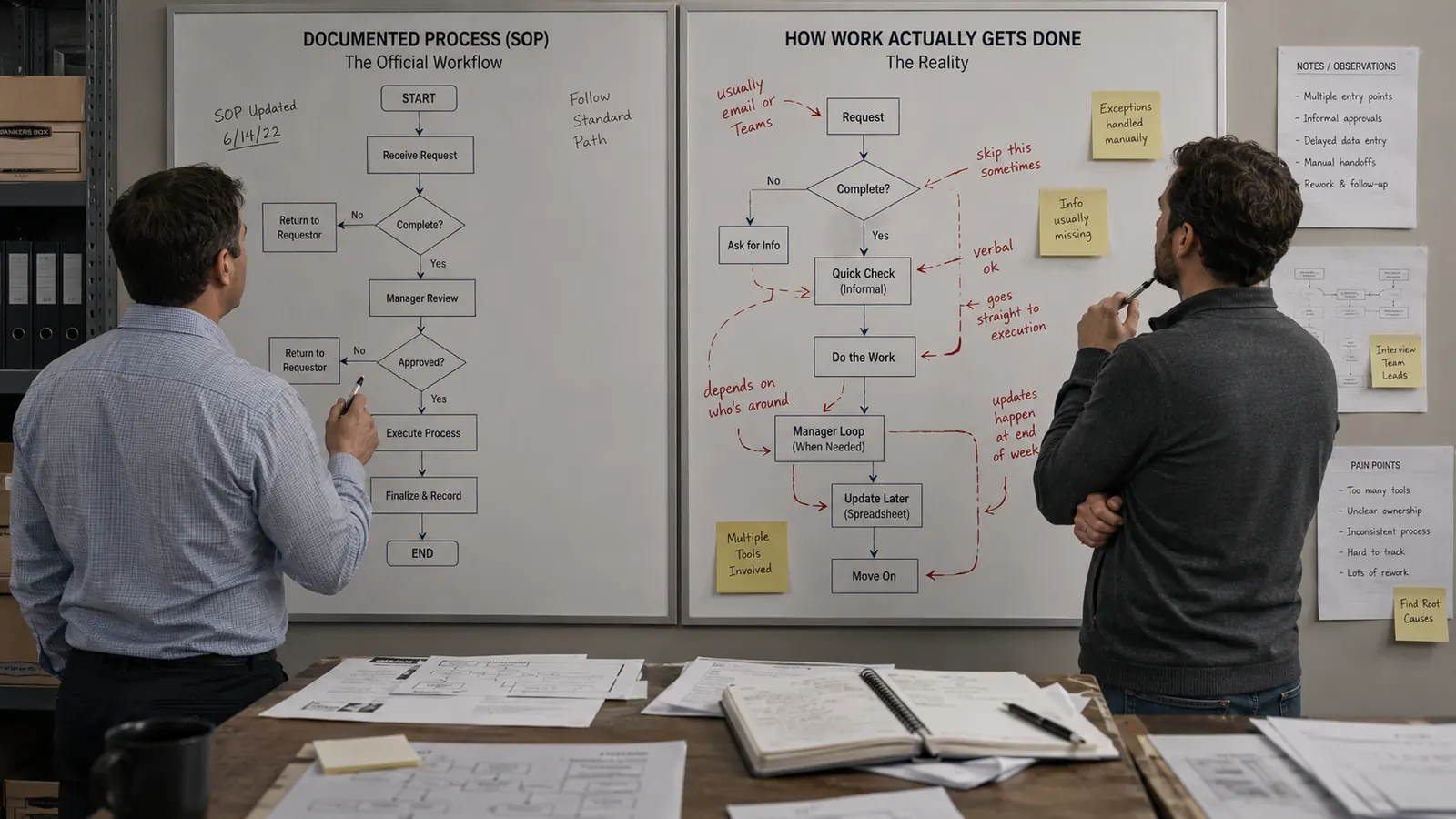 Brief
Brief
How Work Actually Gets Done vs. How It’s Documented
The gap between documented process and operating reality is where AI most often fails.
Read → Article
Automating a Broken Process Scales the Problem
Automation amplifies whatever it inherits. A method for finding and fixing the workflow before AI extends it.
Read →