
AI Inherits Every Data Problem You Haven’t Solved.
Most AI investments don’t fail at the model. They fail at the inputs underneath it — duplicate records, disconnected systems, workaround spreadsheets, tribal knowledge that never made it into the data layer. AI doesn’t ignore those gaps. It runs faster than your team can catch them.
For mid-market operators, the next two years separate compounding from accumulating. Compounding builds margin, throughput, and decisions you can defend. Accumulating produces faster errors, hidden exposure, and a system no one trusts.
- Unify conflicting ERP, CRM, finance, spreadsheet, and field-system data
- Define ownership, data lineage, access controls, and decision rights
- Prepare operational data for workflow automation and AI implementation
Foundation AI Advisory fixes the business foundation first, then applies AI where it can produce measurable operating results.
- Faster reporting cycles
- Lower reconciliation effort
- Cleaner handoffs
- Better workflow automation
- Reduced operating risk
- More reliable AI outputs
Data Curation & Governance Turns Scattered Business Data Into a Trusted Operating System
Before AI can improve the business, leaders need to know which data they trust, who owns it, how it is defined, where it comes from, and where it breaks. Data Curation & Governance turns scattered operational data into a structured, governed, and usable foundation for reporting, workflow automation, and AI.
For mid-market operators, the problem is rarely a total lack of data. The problem is that ERP data, finance reports, spreadsheets, field systems, CRM records, and manual workarounds often tell different versions of the truth. That creates rework, slow reporting cycles, weak handoffs, unclear accountability, and decision risk.
Foundation AI Advisory starts here because AI will not resolve those conflicts on its own. It will inherit the definitions, gaps, exceptions, and ownership issues already inside the business. Our work is to identify the trusted sources, clean the operating data, define ownership, map lineage, and establish controls before AI is designed or implemented.
Assess your data foundation →Common Data Problems We Find Before AI
Foundation AI Advisory’s Business Systems Assessment surfaces these patterns in nearly every mid-market environment. Each one quietly amplifies under automation and AI.
Conflicting definitions
Revenue, margin, customer, project, order, inventory, and utilization are defined differently across teams.
Spreadsheet infrastructure
Critical business logic lives in offline files, personal workbooks, or manual reporting routines.
Unclear ownership
No one owns the definition, quality, access, or correction process for critical operating data.
Disconnected systems
ERP, CRM, finance, field, and project systems do not share a clean operating model.
Weak lineage
Leaders cannot trace where numbers came from, what changed, or why reports disagree.
AI readiness gaps
Data is available, but not structured, governed, or reliable enough for AI-supported workflows.
Most Data Isn’t Broken. It’s Uncontrolled.
Operators don’t lack data. They lack a single, governed version of it. After a decade of system additions, vendor switches, and reporting workarounds, every team has its own answer to the same question — and each one is technically defensible.
-
Three systems, three answers.
The ERP shows one revenue number. The BI tool shows a second. The CFO’s spreadsheet shows a third. None are technically wrong. All use different definitions.
-
A spreadsheet runs the business.
A monthly Excel file owned by one person, exported, reformatted, and emailed to leadership. Lose that person, lose the report.
-
Master data has never been cleaned.
Item, customer, and vendor masters built over a decade. Duplicates, abbreviations, dead records. Plant managers know which ones are real. New hires and AI agents don’t.
-
Reporting is reconciliation, not insight.
Finance closes the books not by analyzing operations, but by chasing why the warehouse number doesn’t match the GL.
-
Common terms mean different things.
“Margin” means four different things depending on who’s in the room. Same for cycle time, on-time delivery, utilization, and lead time.
-
Workarounds became infrastructure.
Ad-hoc Access databases, sticky-note SOPs, integration scripts written by an intern in 2019. Nobody owns them. Everyone depends on them.
This Is Not an IT Problem.
Bad data doesn’t show up on a P&L line. It shows up in every line. The cost is rarely tracked because the symptom is everywhere — slow decisions, missed forecasts, and the quiet margin you can’t recover because you can’t see it leaving.
Pricing exceptions, freight chargebacks, scrap, and rework that no one is reporting because the data lives in three places.
Leadership debates whose numbers are right instead of what to do. Decisions wait for the next reconciliation cycle.
Forecasts built on inconsistent inputs. Variances explained after the fact, not anticipated.
Audit, regulatory, and customer questions answered by reconstructing the trail. Slow, expensive, and incomplete.
Pilots that look good in a demo and fall apart in production. The agent didn’t fail. The inputs did.
Garbage in, amplified garbage out.
AI doesn’t reveal what your data is. It reveals what your data isn’t. Every weakness in the foundation gets scaled.
What We Actually Do.
Five components. Each is operator-grade work, not a slide. Each ties to a business outcome leadership can defend. None require a year of platform investment before value shows up.
Data Mapping & System Alignment
Where every operational data point actually lives. Source systems, downstream copies, and the manual transforms in between. The first deliverable is a map of how data really moves — not how the architecture diagram says it does.
Source-of-Truth Identification
One version of each metric, definition, and master record — with named ownership. Revenue. Margin. On-time delivery. Customer. Item. The arguments end here.
Data Model Restructuring
Item, customer, vendor, and transactional masters cleaned, deduplicated, and structured to support real reporting and downstream automation. Practical passes, not platform overhauls.
Governance & Ownership Definition
Who decides what “active customer” means. Who can change a price master. Who reviews exceptions. Lightweight, enforceable, and built for a team that doesn’t have an enterprise data office.
Access & Control Design
Right people see the right data. Audit trail exists. Role-appropriate access for finance, operations, sales, and external auditors. Operational control — not compliance theater.
What Good Looks Like.
Not theoretical. Not a multi-year roadmap. The end of Step 01 is a real, defensible operating posture — and the foundation every later AI investment depends on.
When these conditions are in place, the operating posture changes. Leaders stop arguing about which number is right and start working from a single version of the truth. Reporting becomes a byproduct of clean systems instead of a monthly reconciliation project. Every AI initiative that follows inherits a trustworthy foundation instead of having to rebuild one.
That is what makes Step 01 worth doing first. It is the only step that makes the rest of the work safe to run at speed.
- One revenue number. One margin number. One on-time delivery rate. Across every system, dashboard, and conversation.
- Reports that don’t require reconciliation. Close the books on time, every month.
- Master data that holds up to a real ERP cleanup pass — and stays clean because someone owns it.
- Clear domain ownership. Finance owns financial masters. Operations owns operational ones. IT supports both.
- Decisions made on data, not despite it. Leadership stops debating numbers and starts debating direction.
- A foundation an AI agent can actually act on — without inheriting the noise of the systems beneath it.
Clean Data Doesn’t Fix a Broken Workflow.
When the data is right, the broken workflows become visible. That’s the next problem — and the next page. Process is where AI gets applied. Not before.
Business Systems Assessment
A focused evaluation of how the business actually operates across data, workflows, and systems. Output: a prioritized execution path tied to measurable business outcomes.
90-Day AI Execution Sprint
A targeted conversation about the 90-Day AI Execution Sprint and the workflow where execution should start.
Recent Thinking on Data
 Part 1 of 5
Data: The Constraint You Can’t Outrun
Why mid-market AI initiatives stall on data quality, ownership, and structure before any model is involved.
Read →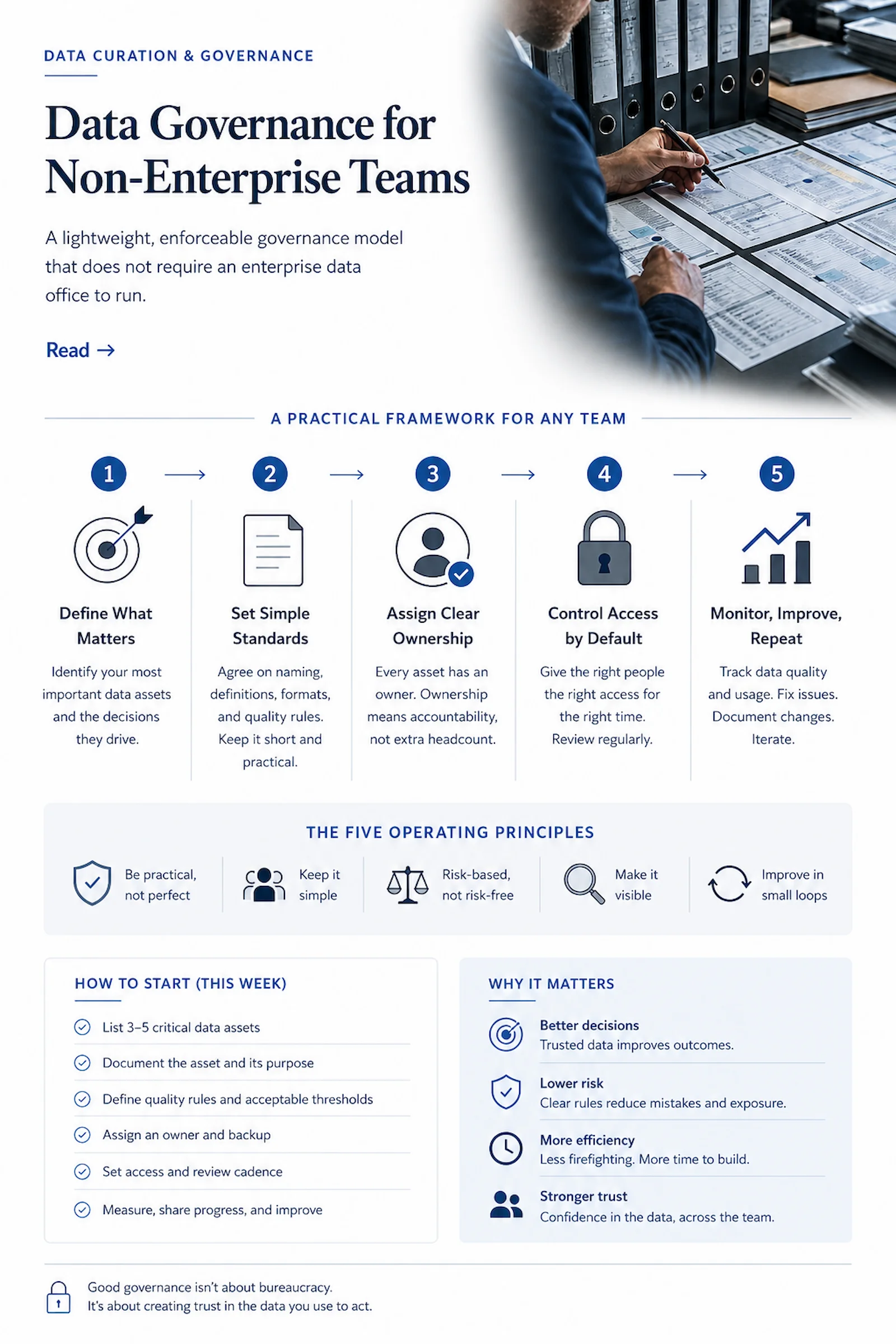 Infographic
Data Governance for Non-Enterprise Teams
A lightweight, enforceable governance model for mid-market teams that need trusted data without enterprise data-office overhead.
Read → Part 5 of 5
Governance: The System That Holds It Together
Lightweight governance for mid-market AI: ownership, controls, escalation paths, and human oversight at the right points.
Read →Get Foundation AI Advisory’s running record on mid-market AI execution.
Insight assets for mid-market operators. Published when there is something worth publishing.
We do not share your information. Unsubscribe any time.