
Data governance fails in mid-market companies when it is designed for an organization that does not exist.
Most operators do not have a chief data officer, a stewardship council, a dedicated metadata team, or the budget to stand up enterprise governance software before decisions have to be made. They have an ERP, a CRM, spreadsheets, reporting workarounds, and people who know which numbers are safe to trust. That reality does not make governance impossible. It changes what governance has to be.
Lightweight governance starts with one practical question: what data must the business trust before AI can support decisions?
For most companies, the first answer is narrow. Customer records. Item masters. Vendor data. Pricing rules. Inventory balances. Job, order, or invoice data. These are the datasets that drive margin, cash flow, throughput, and risk exposure. If they are inconsistent, every downstream report, workflow, and AI output inherits the inconsistency.
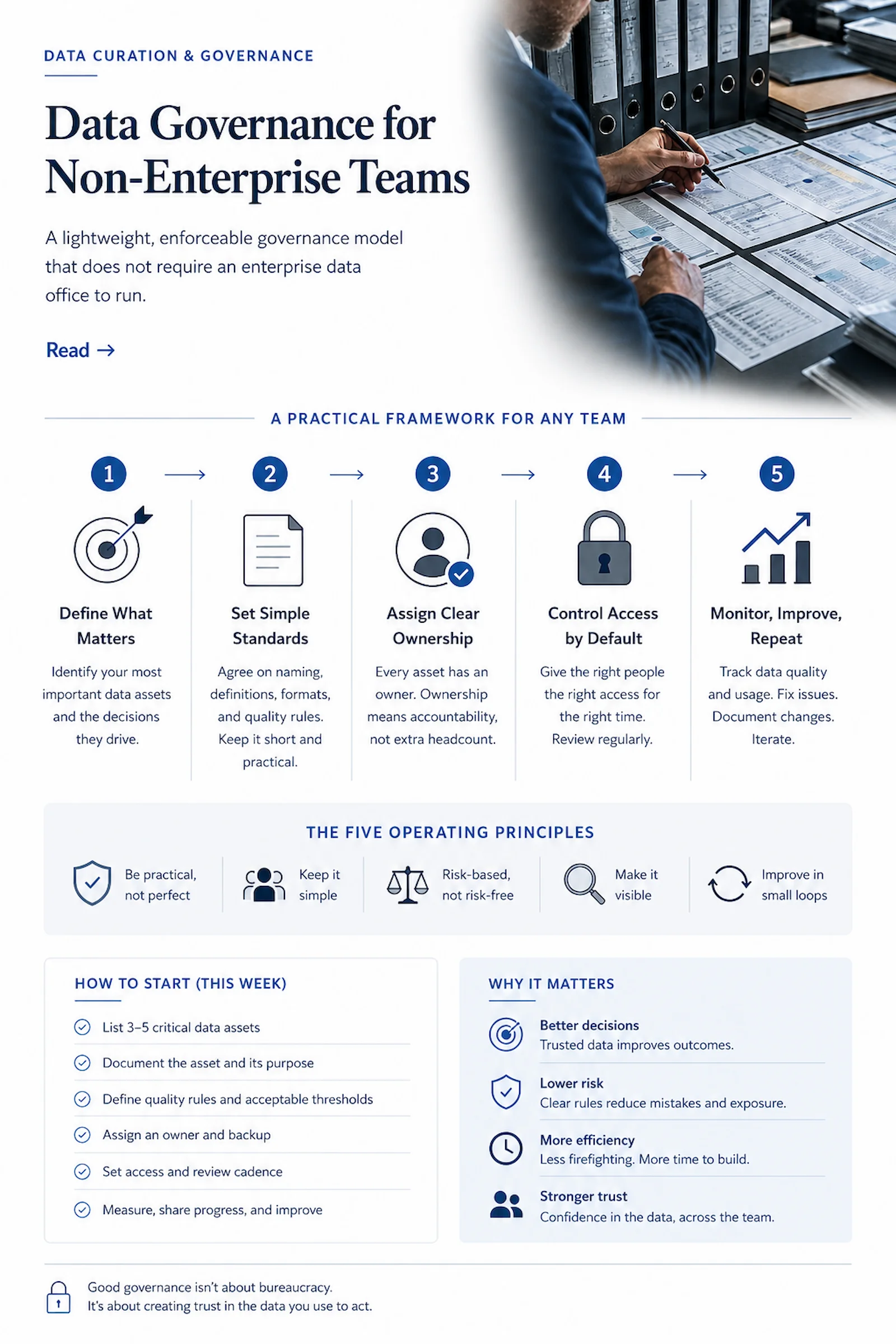
The first operating principle is to define what matters. Do not govern everything. Identify the few datasets that shape important decisions and document why they matter. This keeps the work focused and prevents governance from becoming a policy exercise.
The second principle is to set simple standards. Naming conventions, required fields, allowed formats, and quality rules should be short enough for the people entering data to understand and follow. If a rule cannot survive daily operations, it is not a governance rule. It is decoration.
The third principle is ownership. Every critical dataset needs a named owner and a backup. Ownership does not mean the person enters every field. It means they approve definitions, resolve conflicts, and decide what happens when systems disagree.
The fourth principle is access control by default. The right people need the right access at the right time. Uncontrolled edits create silent risk. Overly restricted access creates workarounds. The goal is controlled movement, not locked cabinets.
The fifth principle is continuous improvement. Data quality changes as customers, products, vendors, and workflows change. Governance needs a review cadence, visible measures, and a way to fix issues before they become embedded in reports or automation.
This is why lightweight governance is an operating model, not a documentation project. It creates trust in the data people use to act.
For AI, that trust is not optional. Models and agents cannot resolve competing definitions on their own. They will choose from the data they are given and produce output with whatever contradictions exist underneath. Governance reduces that ambiguity before speed and scale make it more expensive.
The payoff is not bureaucracy. It is fewer reconciliations, faster approvals, cleaner reporting, and stronger confidence when automation enters the workflow. A small team can govern data if the rules are visible, the owner is named, and the review rhythm is real. That is enough to begin, and enough to improve without adding overhead.
A practical starting point is simple. List three to five critical data assets. Document the business decision each one supports. Define acceptable quality thresholds. Assign an owner and backup. Set access and review cadence. Measure issues, share progress, and improve in small loops.
This work will not look like enterprise governance. That is the point. Mid-market governance has to be practical, visible, enforceable, and close to the work. When it is, AI has something stable to build on.