
Financial Services & Banking
AI in Financial Services Must Be Governed Around Controls, Reporting, and Risk.
Financial services and banking environments require a different level of discipline. The business depends on trust, controls, compliance, reporting accuracy, risk management, customer data, auditability, documentation, approvals, and operational consistency.
AI in Financial Services Requires Controls Before Automation
Financial services and banking environments depend on trust, controls, reporting accuracy, risk management, auditability, compliance, customer data, and operational discipline. AI cannot be treated as a bolt-on tool in this environment. It has to be designed around ownership, traceability, and control.
Foundation AI Advisory helps financial services and banking organizations strengthen the data, workflows, governance, and decision controls required before applying AI. The work starts with the operating environment, not the model.
AI can support reporting, document review, customer operations, risk workflows, compliance support, finance operations, knowledge retrieval, and internal productivity. But it only works when data definitions, access rights, review processes, and accountability are clear.
- Reporting
- Document review
- Customer operations
- Compliance support
- Risk workflows
- Finance operations
- Knowledge retrieval
- Internal productivity
Where the Methodology Meets Financial Services & Banking.
AI can support the work, but it must be designed around governance from the start.
Foundation AI Advisory does not treat financial services AI as a generic automation opportunity.
Data First. Workflow Second. AI Third.
Foundation AI Advisory evaluates this industry through its core methodology — in order.
Data Curation & Governance
Financial institutions and financial services firms rely on sensitive, regulated, and decision-critical data. Customer records, account information, transaction data, lending files, compliance records, reporting logic, policies, risk ratings, approvals, and audit trails must be governed carefully.
If the underlying data is incomplete, poorly classified, inconsistently maintained, or difficult to trace, AI introduces risk. It may summarize records incorrectly, miss policy context, expose sensitive information, or create outputs that cannot be properly reviewed.
Foundation AI Advisory evaluates the data environment through the lens of business control. Who owns the data? Where does it live? Which system is authoritative? How is access controlled? How is quality reviewed? How are outputs validated? Can decisions be traced?
Workflow Optimization
Financial services workflows often contain necessary control points. The objective is not to remove controls blindly. The objective is to distinguish between controls that reduce risk and friction that slows the business without adding meaningful protection.
Foundation AI Advisory reviews workflows such as onboarding, document intake, lending support, compliance review, reporting, customer service, exception management, approvals, reconciliation, policy review, and management reporting.
The business impact is measurable. Cleaner workflows can reduce cycle time, improve customer response, reduce manual review burden, strengthen auditability, and improve visibility into operational risk.
AI Design & Implementation
AI can support financial services in targeted ways: document classification, policy retrieval, customer communication support, compliance review assistance, exception triage, management summaries, reconciliation support, research, reporting support, and internal knowledge access.
But AI must operate within defined boundaries. Human review is required for sensitive decisions, regulatory matters, customer commitments, credit decisions, compliance determinations, and risk judgments. Foundation AI Advisory designs workflows so AI supports accountable professionals rather than replacing them in areas where judgment and control matter.
In this industry, AI earns its place only when it improves execution while respecting the control environment.
Tied to Margin, Throughput, Cycle Time, Cash Flow, Risk, and Visibility.
What Foundation AI Advisory delivers, by audience.
Improved operating discipline without weakening trust.
Cleaner reporting, better controls, faster reconciliation support, and reduced manual burden.
Stronger auditability, clearer exception handling, and better documentation control. (For risk and compliance leaders, the same applies.)
A structured AI architecture that protects data, access, traceability, and governance.
Related Thinking
 Part 5 of 5
Governance: The System That Holds It Together
Lightweight governance for mid-market AI: ownership, controls, escalation paths, and human oversight at the right points.
Read →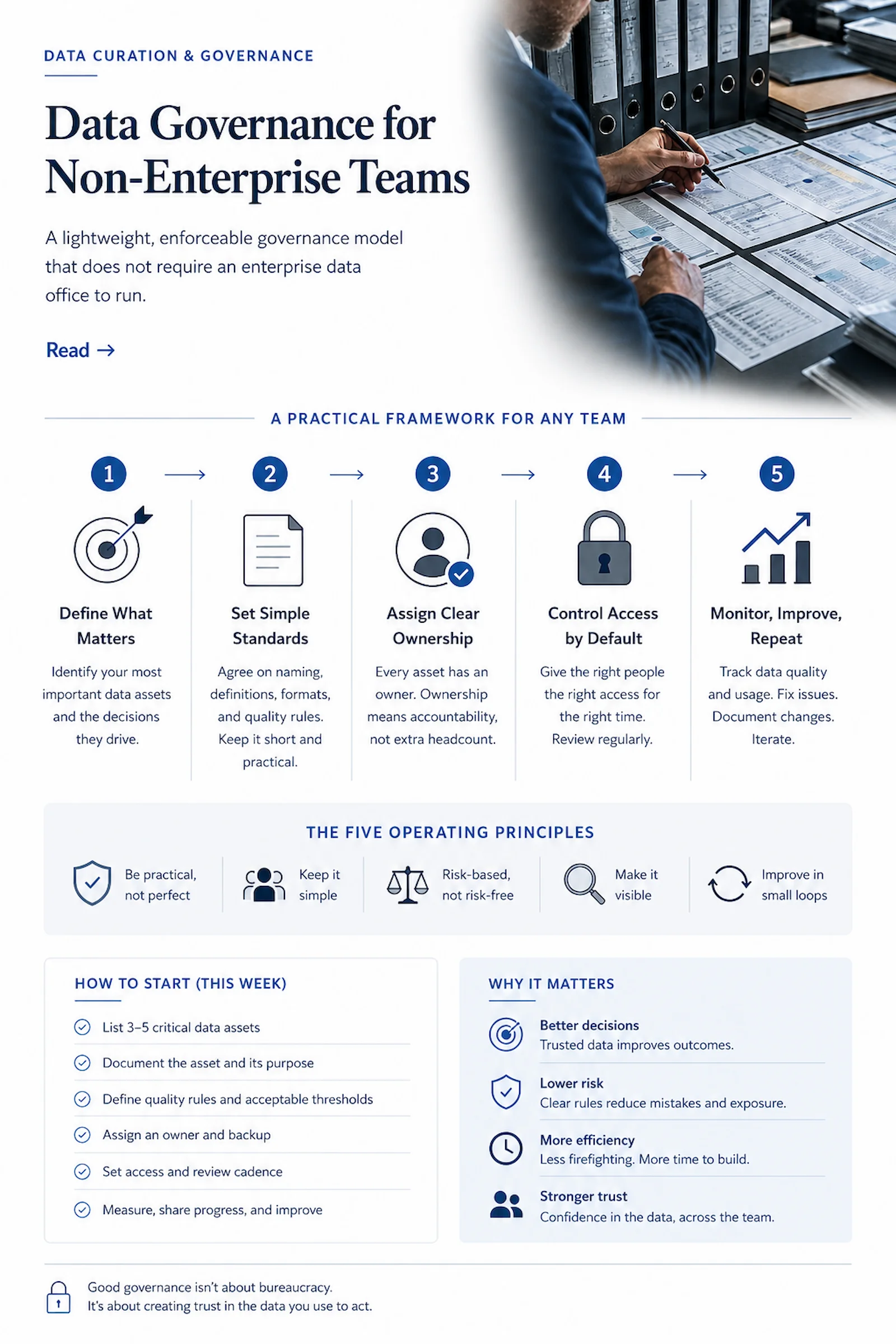 Infographic
Data Governance for Non-Enterprise Teams
A lightweight, enforceable governance model for mid-market teams that need trusted data without enterprise data-office overhead.
Read → Article
Where Agents Earn Their Keep — and Where They Don’t
A decision framework grounded in margin, throughput, cycle time, and risk. Built for operators making capital decisions, not for teams chasing demos.
Read →Financial services organizations should not pursue AI because competitors are talking about it.
They should pursue AI where the workflow is defined, the data is governed, the risk is controlled, and the business outcome is measurable.