
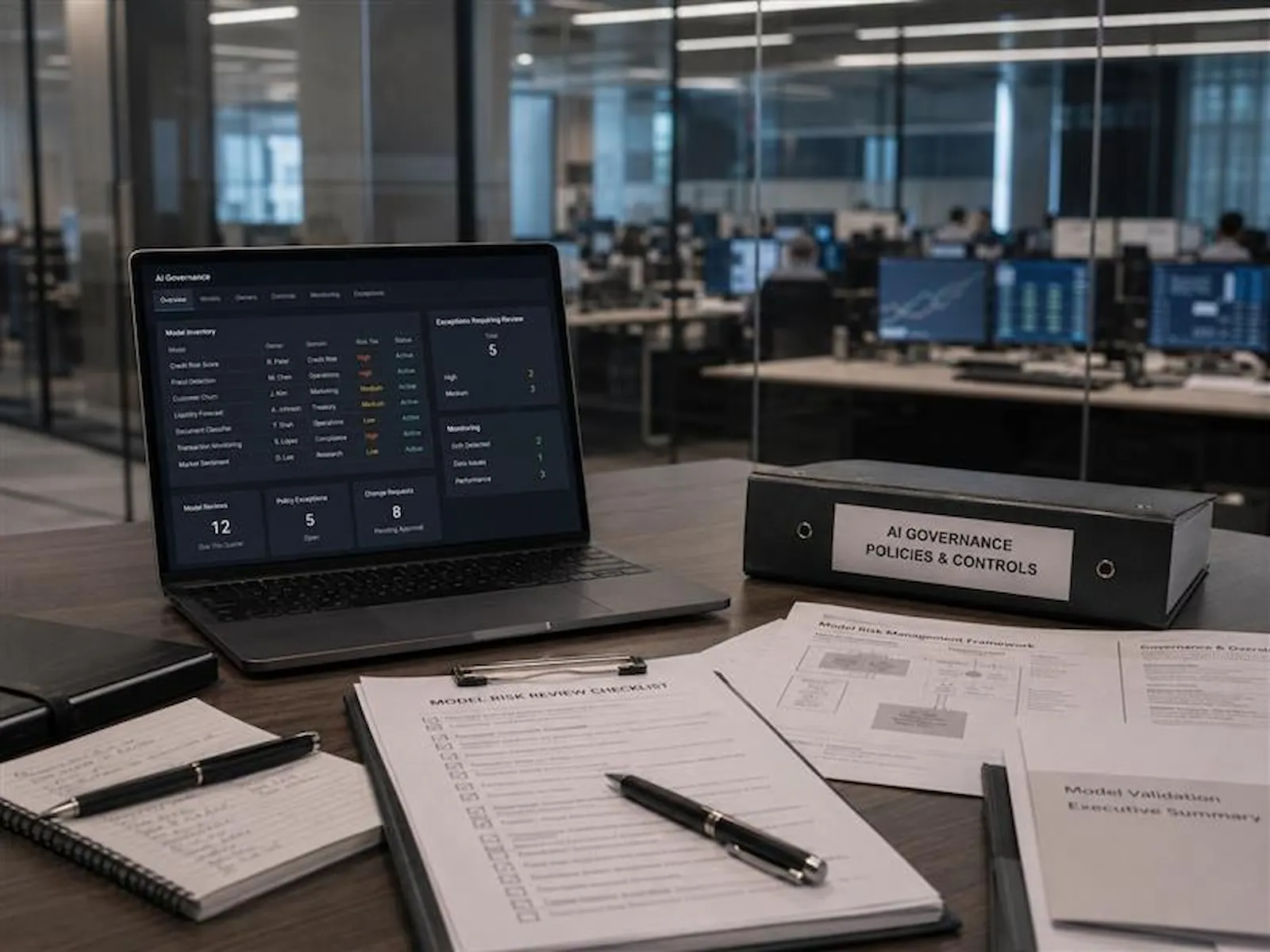
Most AI governance in the mid-market is a policy document sitting in a shared drive. Someone wrote it, leadership signed it, and nobody opens it again until an auditor, board member, customer, or insurer asks.
That is not governance. That is documentation.
Real governance is the operating system that determines whether AI can safely create value inside a working business. The gap between the two is where mid-market companies may learn expensive lessons.
The distinction matters because one of us spent years inside model risk governance at a Fortune 500 bank, working in the discipline shaped by SR 11-7 and now updated through SR 26-2. Banks did not develop that discipline because it was fashionable. They developed it because models can fail in ways that cost real money, distort decisions, and create risk the business cannot see until it is too late.
In that world, you do not get to treat models as magic. You have to know what data went in, what assumptions were made, where the model performs well, where it breaks, who owns the output, who reviews exceptions, and what happens when the answer is wrong.
The mid-market is adopting AI quickly, but most companies are not building the operating discipline underneath it at the same pace.
Why the Mid-Market Is Exposed
A regional manufacturer in Northeast Ohio, $120M in revenue, is a useful composite.
The sales team is using an AI-assisted quoting tool that pulls historical pricing and suggests margins. The operations group has a vendor-supplied forecasting model feeding the production schedule. Procurement uses a vendor risk-scoring tool that summarizes supplier performance and flags which vendors may create delivery or cost risk.
Three different functions, three different tools, three different vendors, and no single person in the building can answer basic questions about all of them.
Who validated the outputs before go-live? What assumptions are baked into the model? What happens when the model is wrong? Who owns the decision to keep using it?
This is not a hypothetical. It is a common state of AI adoption in companies between $25M and $500M in revenue.
The tools work well enough in demos that the operational discipline never gets built. Banks spent years constructing that discipline under regulatory pressure. Mid-market operators are adopting the technology in months, often without the same governance muscle, and no regulator is going to force the question for them.
AI Does Not Remove Operational Risk. It Scales Whatever Risk Is Already There.
This is the part vendor demos rarely show.
The demo runs against clean data, a curated scenario, and a workflow designed to make the tool look useful. Your business runs against messy data, edge cases, and processes that have accumulated workarounds for years.
When you put AI on top of a broken process, you do not get a fixed process. You get a broken process running at machine speed, producing more outputs that look authoritative, with fewer humans in the loop catching the errors.
The forecasting model in the composite above is a good example. If the historical demand data has a structural bias from a discontinued product line, the model can carry that bias forward into production decisions until someone notices the inventory problem months later.
The vendor risk tool is another. If it overweighted a supplier’s old delivery issues while missing a new constraint in the current supply base, the company may shift purchasing decisions for reasons no one has validated.
The quote tool is the third. If the pricing logic is wrong on a niche SKU, the sales team can close deals at margins that erode gross profit before finance reconciles the quarter.
None of these are AI problems. They are governance problems that AI made faster and harder to see.
What Governance Actually Produces
This is where the gap between policy documents and real governance becomes concrete.
A company that actually governs its AI can produce the following artifacts without scrambling.
A model inventory
Every AI or algorithmic system in production, what it does, what business decision it informs, what data it consumes, and what vendor or internal team owns it.
Most mid-market companies cannot produce this list because no one has ever assembled it.
Documented assumptions
For each system, the assumptions baked into how it was built and what conditions have to hold for its outputs to be trustworthy.
When the assumptions break, someone is supposed to know.
Defined ownership at the role level
Not “IT owns AI.”
A named role owns each system and is accountable for performance, monitoring, and the decision to retire it. Role level, not person level, because people leave.
An exception process
When the model says one thing and the operator believes something else, what happens?
Who has the authority to override, what gets logged, and how does the override data feed back into the system?
Monitoring triggers
Thresholds that, when crossed, force a review.
Drift in input data, degradation in accuracy, shift in business mix. Without triggers, monitoring becomes a quarterly meeting where someone says things are fine.
Change control
When the vendor pushes an update, when the prompt template gets rewritten, when the model is retrained, that change is logged, reviewed, and either approved or rolled back.
The version in production should be documented and reproducible.
If a company has these six things, it has governance.
If it has a policy document and none of these things, it has paperwork.
The distinction is not academic. It is the difference between knowing what your AI is doing and finding out from a customer, an auditor, an insurer, or a lawyer.
How Foundation AI Advisory Approaches It
Foundation AI Advisory was built in Cleveland to serve operators in the markets we know: manufacturing, construction, logistics, and professional services.
We work with companies that built something real and now need to figure out where AI fits without betting the business on a vendor pitch.
Our methodology is simple:
Data first. Process second. AI last.
Governance is not a separate workstream bolted onto the end. It is built into the sequence, because the artifacts above cannot exist if the data is not curated and the process is not understood.
We work in 90-day sprints, vendor-neutral, with deliverables that survive the engagement.
Mid-market companies do not need governance theater. They need practical governance that lets them move faster without pretending the risk is not real.
If you are running AI in your business and you cannot produce the six artifacts above, that is the conversation.
We should talk.
Frequently Asked Questions
- What is AI governance?
- AI governance is the operating discipline that defines how AI systems are inventoried, owned, monitored, changed, reviewed, and controlled inside a business. It is not simply a policy document. Real governance produces a model inventory, documented assumptions, role-level ownership, exception processes, monitoring triggers, and change-control records — the artifacts that determine whether AI can safely create value inside a working business.
- Why does AI governance matter for mid-market companies?
- Mid-market companies are adopting AI quickly across sales, operations, finance, procurement, and customer service. Without governance, AI scales whatever risk is already in the business — bad data, weak workflows, unclear ownership, and unvalidated assumptions. Banks built this discipline under regulatory pressure over many years; mid-market operators are adopting the technology in months, often without the same governance muscle, and no regulator is going to force the question for them.
- What should an AI model inventory include?
- A model inventory should include every AI or algorithmic system in production, what it does, what business decision it informs, what data it consumes, who owns it, what vendor or internal team supports it, and how performance is monitored. Most mid-market companies cannot produce this list because no one has ever assembled it.
- What are practical AI governance artifacts?
- Practical AI governance artifacts include a model inventory, documented assumptions, role-level ownership (named role, not named person), exception processes that define who can override and how overrides are logged, monitoring triggers that force review when thresholds are crossed, and change-control records that document vendor updates, prompt rewrites, and retraining events. If a company has these six things, it has governance. If it has a policy document and none of these things, it has paperwork.
Need to know where AI risk is already entering the business?
Foundation AI Advisory helps mid-market operators identify the data, workflow, ownership, and governance gaps that determine whether AI can safely scale.
Start with a Business Systems Assessment