
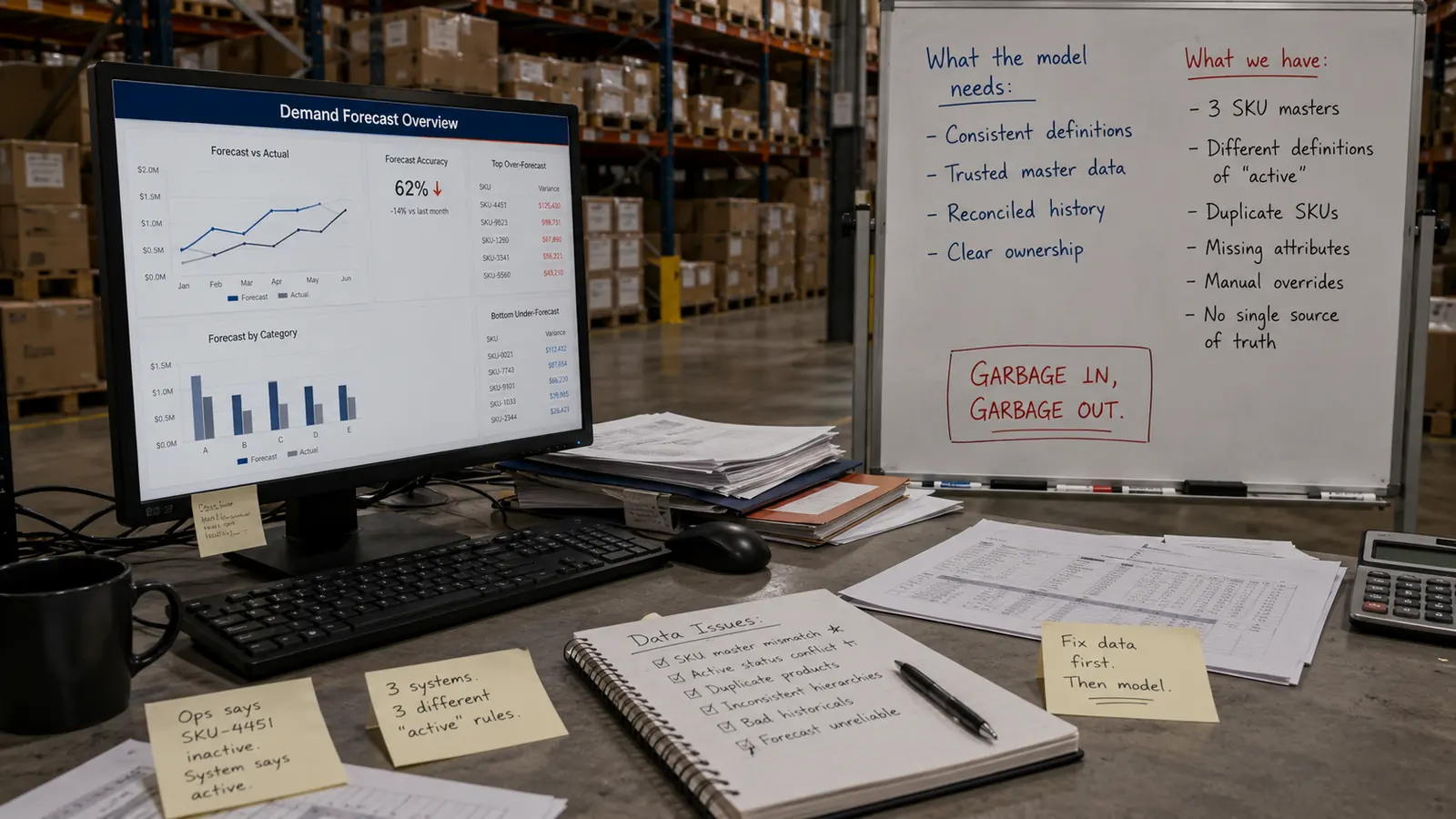
Most failed AI projects do not fail for the reason the executive team thinks. The model was not wrong. The data the model was asked to think with did not agree with itself. By the time anyone notices the results look strange, the problem has had six months to compound. The AI did not underperform. It performed exactly as designed — on inputs that were never ready to be trusted.
The misdiagnosis
The pattern is consistent. A demand forecasting model produces guidance operations refuses to act on, because they have known for years that the SKU master is a mess and three legacy systems disagree on what “active” means. A customer segmentation engine groups accounts in ways the sales team finds nonsensical, because the CRM has four versions of the same logo and no rule for which one wins. An AP automation rollout flags invoices the controller has been quietly approving as exceptions for a decade, because the GL coding logic was never written down.
In each case, the post-mortem lands on the model. The vendor is questioned. The training data is blamed. A second pilot is scoped. Budget gets approved for a different tool.
This is the misdiagnosis. The model was not the problem. The model did exactly what models do. It produced output at the speed of its inputs. The inputs were broken in ways the organization had quietly accommodated for years.
The reporting layer absorbed that accommodation. Analysts reconciled. Controllers footnoted. Account managers explained. The numbers worked because humans were patching the seams in real time.
AI does not patch seams. It produces.
What “clean” actually means
The phrase “clean data” creates a false standard. Executives hear it and picture a pristine warehouse no operating business has ever had. That picture is wrong, and it is the reason most data initiatives stall before they start.
Usable is the standard. Not perfect.
Usable means the data needed for a specific decision is structured, governed, owned, reconcilable, and defined the same way by everyone who touches it. It does not mean every record in every system is correct. It means the subset of data the AI is being asked to act on holds up under scrutiny.
A demand model does not need a perfect customer master. It needs a customer master where the definition of “customer” is the same in sales, finance, and operations. A cash forecasting model does not need every invoice tagged correctly. It needs the aging buckets and payment terms to mean what the controller thinks they mean.
This is a usability standard, not an aesthetic one. It is also a far smaller and more tractable problem than “fix all of our data,” which is the framing that kills budgets and stalls programs.
The question is not how clean the data is. The question is whether the data, as it exists today, is fit for the specific decision the AI is being asked to support. Most of the time, the answer is no. The gap is usually narrower than the leadership team fears.
Why AI exposes the problem faster than reporting did
AI is an amplifier, not a corrector. That distinction is the part most executives miss until after they have approved the budget.
Reporting tolerated bad data for thirty years because reporting was consumed by humans who knew the business. When a regional sales number looked off, someone in finance opened the records, found the duplicate account, fixed the rollup in the deck, and moved on. The patch happened in the analyst’s head, in the spreadsheet, in the footnote, in the conversation before the meeting.
That patching was invisible. It was also load-bearing. It was the reason the executive team could trust a report built on top of years of accumulated inconsistency.
AI removes the analyst from the loop. The output is produced, surfaced, and acted on before a human has the chance to reconcile anything. A misclassified vendor becomes a payment recommendation. A drifted SKU master becomes a procurement order. A definitional disagreement between sales and finance becomes a forecast the board is asked to approve.
Bad inputs running through human review produce a slow, manageable distortion. Bad inputs running through automated decisioning produce a fast, scaled distortion at the speed of the workflow itself.
This is why AI pilots so often “fail” within ninety days. They did not underperform. They worked exactly as designed and revealed, in compressed time, what the reporting layer had been quietly hiding.
The thirty-minute diagnostic
Before approving an AI initiative, an executive can run a thirty-minute diagnostic. Alone, or with one or two operators in the room. No consultant. No vendor demo. No workshop.
Pick one decision the AI is supposed to support. Cash forecasting accuracy. Customer churn prediction. Inventory reorder timing. Pick one.
Now trace the data backward. What fields feed that decision? What system holds them? Who owns each field — not in the org chart sense, but in the practical sense of who is accountable when the value is wrong? How is each field defined, and would the head of sales, the controller, and the operations lead all give the same definition if asked separately?
Then ask the harder question. When two systems disagree on a value, which one wins, and why? Is that rule written down, or is it lived in someone’s head? When that person leaves, what happens?
If the answers are crisp and consistent, the data foundation is fit for the use case, and the AI initiative has a real chance of producing measured outcomes. If the answers wobble, contradict, or require translation, the AI will amplify those gaps faster than the team can intercept them.
This is not a sophisticated test. It is a question of whether the organization has its house in order for the specific decision in question. Most teams have never asked it. The full set of questions worth working through before approving an initiative is collected on the AI Decision Questions page.
The reframe
AI is a margin, throughput, cycle-time, and visibility decision before it is a technology decision. The question is not which model. The question is which decision, on which data, with which owner, producing which outcome.
The firms getting real returns from AI are not the ones with the best vendor relationships. They are the ones who sequenced the work correctly: Data Curation & Governance, then Workflow Optimization, then AI Design & Implementation. In that order. Not because the order is academically tidy, but because the order is operationally true. Each stage depends on the one before it. Skip one, and the rest collapses into expensive theater.
The AI is the easy part. The foundation underneath it is the work. Get the foundation right, and the AI produces what it was bought to produce. Get it wrong, and the AI proves, quickly and publicly, that there was never a foundation to begin with. The fastest practical way to put that foundation in place is the Business Systems Assessment.
Frequently Asked Questions
- Why do most AI pilots fail in mid-market companies?
- Most AI pilots fail because the data the model was asked to think with did not agree with itself. The model performed exactly as designed, but on inputs that were never ready to be trusted. The post-mortem usually lands on the model, the vendor, or the training data — and a second pilot gets scoped. The misdiagnosis is the pattern. The model produced output at the speed of its inputs, and the inputs were broken in ways the organization had quietly accommodated for years through manual reconciliation in the reporting layer.
- What does “clean data” actually mean for AI readiness?
- Usable is the standard, not perfect. Usable means the data needed for a specific decision is structured, governed, owned, reconcilable, and defined the same way by everyone who touches it. A demand model does not need a perfect customer master — it needs a customer master where the definition of “customer” is the same in sales, finance, and operations. A cash forecasting model does not need every invoice tagged correctly — it needs the aging buckets and payment terms to mean what the controller thinks they mean. This is a usability standard, not an aesthetic one, and it is a far smaller and more tractable problem than “fix all of our data.”
- Why does AI expose data problems faster than traditional reporting did?
- Reporting tolerated bad data for thirty years because reporting was consumed by humans who knew the business. Analysts reconciled, controllers footnoted, account managers explained — the patching happened in a human’s head, in a spreadsheet, in a conversation before the meeting. That patching was invisible and load-bearing. AI removes the analyst from the loop. The output is produced, surfaced, and acted on before a human has the chance to reconcile anything. Bad inputs through human review produce slow, manageable distortion. Bad inputs through automated decisioning produce fast, scaled distortion at the speed of the workflow itself.
- What is the 30-minute diagnostic for AI readiness?
- Before approving an AI initiative, an executive can run a short diagnostic alone or with one or two operators. Pick one decision the AI is supposed to support — cash forecasting accuracy, customer churn prediction, inventory reorder timing. Trace the data backward. What fields feed that decision? What system holds them? Who owns each field in the practical sense of who is accountable when the value is wrong? How is each field defined, and would the head of sales, the controller, and the operations lead all give the same definition if asked separately? When two systems disagree on a value, which one wins, and is that rule written down? If the answers are crisp, the data foundation is fit for the use case. If the answers wobble, the AI will amplify those gaps faster than the team can intercept them.
- What is the right sequence for deploying AI in an operating business?
- The firms getting real returns from AI sequence the work correctly: Data Curation & Governance, then Workflow Optimization, then AI Design & Implementation. In that order. Not because the order is academically tidy, but because the order is operationally true. Each stage depends on the one before it. Skip one, and the rest collapses into expensive theater. The AI is the easy part. The foundation underneath it is the work.